
Blog | 6 minutes read time
Neighbourhood Verbenas: Madrid’s Most Authentic Summer Tradition
If you’ve lived in Madrid for a while, you’ve probably heard the word “verbena” thrown around sometime between July and August. If you’re new to the city, it might sound like just another festival name, but a verbena is something much more specific, and much more local, than that. It’s arguably the most authentic plan Madrid has to offer in summer, and it happens right in your own neighbourhood, whether you know it or not.
What exactly is a verbena?
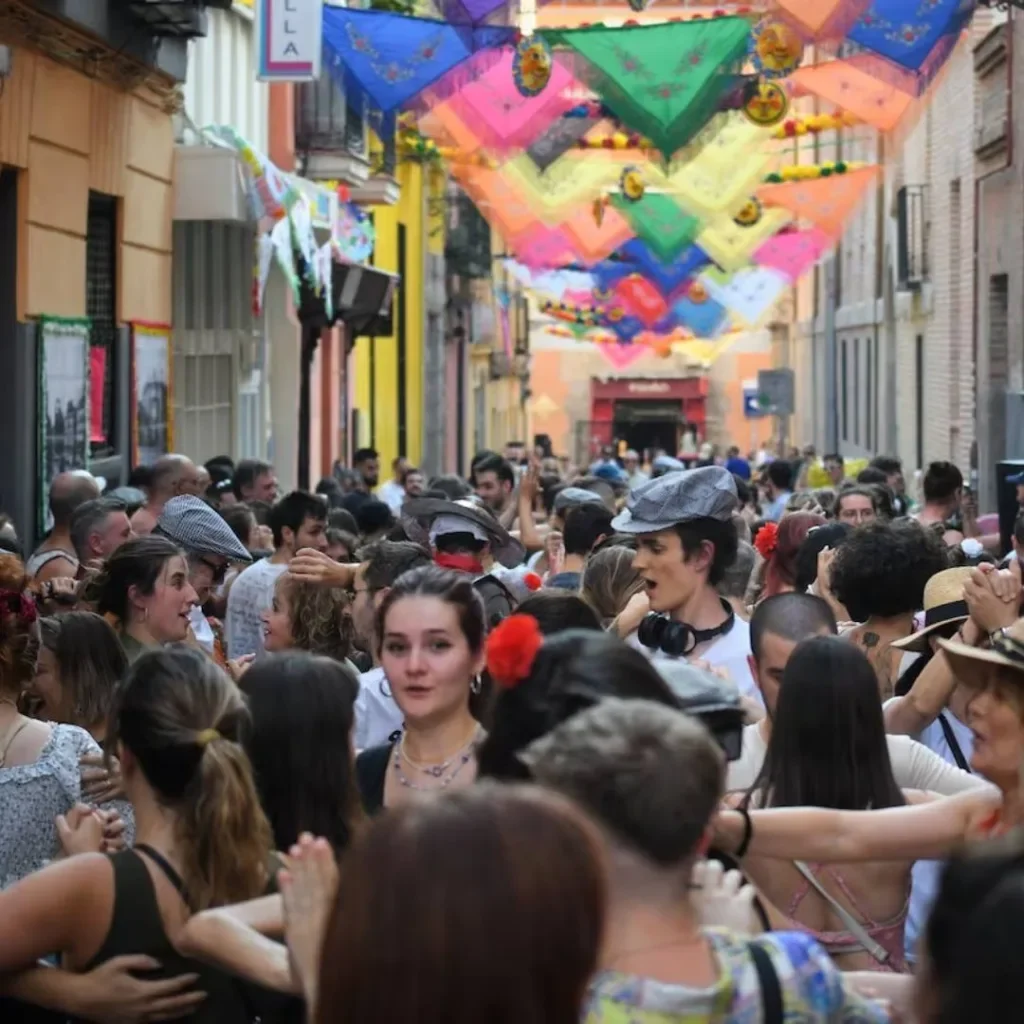
A verbena is a neighbourhood street festival, usually held at night, in honour of a local patron saint. The tradition goes back to the mid 19th century, when verbenas became the great festive outlet for working class Madrid residents, who had few other forms of leisure available to them. Every district organised its own celebration: balconies were dressed with shawls, colourful handkerchiefs were hung across the streets, and paper garlands filled the air, while squares and courtyards turned into open air dance halls.
That spirit has barely changed. Today a verbena still means decorated streets, makeshift food and drink stalls, live music, and an entire neighbourhood out on its feet well into the night — no ticket required.
🔵 The big three: San Cayetano, San Lorenzo and La Paloma
While practically every district in Madrid has its own verbena at some point in the year, three of them have become genuinely iconic, and they all happen back-to-back in the same corner of the city each August. The festivities begin with San Cayetano in the Rastro/Embajadores neighbourhood, continue with San Lorenzo in Lavapiés, and culminate with the biggest and most popular of them all, La Paloma, in La Latina.
🔵 In 2026, the dates line up like this:
📅 San Cayetano — 5 to 8 August, centred around Plaza General Vara del Rey and the Cascorro area.
📅 San Lorenzo — 9 to 12 August, in and around Plaza Arturo Barea and the church of San Lorenzo in Lavapiés.
📅 La Paloma — 14 to 17 August, with its heart in Las Vistillas gardens and Plaza de la Paja, extending down Calle Toledo.
👉🏻 Take a look to the official site 🔗 Offical site – Learn more
Because the three neighbourhoods sit so close together, it’s entirely possible to walk from one verbena to the next over the course of the two weeks, which is exactly what many Madrileños do. Each one, though, keeps its own character while sharing that unmistakably castizo look: streets decorated with paper lanterns, dressed-up balconies, and locals in chulapo and chulapa outfits.
La Paloma is the grandest of the three and is held in honour of the Virgen de la Paloma. Around its main day, expect regional dances, zarzuela performances, a pasodoble competition, chotis dancing, mantón displays, and tastings of traditional local food.
🔵 It doesn’t stop in August
Verbena season actually gets going well before the big three. Mid-July already brings a wave of neighbourhood festivities across the city. In Puente de Vallecas, the Fiestas del Carmen run from 12 to 19 July, while in Carabanchel the combined Fiestas del Carmen y Santiago stretch from 16 to 26 July. Chamberí holds its own Fiestas del Carmen around the same dates, with concerts, sports and food taking centre stage there, while Vallecas is known for being the rowdier, more free-spirited of the two.
Villaverde, in the south of the city, spreads its celebrations across two separate events — Villaverde Alto from 17 to 20 July and Villaverde Bajo from 24 to 27 July — each with its own concerts and fairground rides. By the time August arrives and the big three verbenas take over the city centre, Madrid has effectively been living in festival mode for nearly a month.
🔵 The music
Every verbena has its own soundtrack, but a few elements repeat across all of them: the chotis, Madrid’s traditional couples’ dance, danced almost on the spot with short, precise steps; pasodoble competitions; live zarzuela performances; and, increasingly, tribute bands and contemporary acts that keep younger crowds coming back. Expect a mix of generations dancing side by side — grandparents in full chulapo dress next to teenagers filming it all for social media.
🔵 The street food
Verbenas are also a culinary tradition in their own right. Street stalls sell churros, roasted almonds, and, above all, the verbena’s signature drink: homemade limonada, a wine-based punch with fruit that’s stronger than its name suggests. Tapas routes pop up around the main squares, giving you an easy excuse to hop between bars while following the music from one street to the next.
Why it’s the most local plan of the summer
Big festivals like Veranos de la Villa bring international names and polished programming. Verbenas are the opposite: they’re organised by and for the neighbourhood, funded by very modest budgets, and powered almost entirely by community spirit. There’s no stage design, no sponsorship banners, and often no entry gate at all — just a street, some lanterns, a sound system, and everyone who lives nearby.
For newcomers, that’s exactly what makes them worth seeking out. A verbena is where you’ll hear Madrid dialect at full speed, learn a dance step or two whether you meant to or not, and understand, in a very direct way, what “barrio” really means in this city.
In short: Between mid July and the third week of August, Madrid’s neighbourhoods hand the city over to its oldest summer tradition. From Vallecas and Carabanchel in July to San Cayetano, San Lorenzo and La Paloma in August, verbenas are cheap, loud, and completely unfiltered, the kind of plan most newcomers never hear about until someone local drags them into one.
Live the city like a local while building your career with us, because the best way to understand Madrid is to dance in its streets at least once.